Sunday, 14 December 2008

AGAP-North Bound

Having completed the acclimatisation at Ack camp we had our first survey flight to AGAP-South from South Pole. Ack camp involved us doing light work and been feed great food by our chef Dan and sometimes by our medic Mel. Day 3 of acclimatisation we installed mag and GPS base stations to make checking the data easier and reducing our reliance on other sources of data down the road.
South Pole Station

On the touristy front we had our pictures taken by the South Pole both the symbolic one and the geographical one. We saw the old South Pole base which is a Dome and looks quite futuristic rising out of the snow. The new one is a modern two story building on stilts quite different in terms of scale to everyone else’s bases here been twice the size of most countries main bases. Weather here is mostly around -30°C with either zero wind or up to 12 knots of wind.

The first survey flight into AGAP South was a bit of a long haul taking some 9-10 hours involving refuelling at AGAP South before the return, so took both our pilots to avoid pilot fatigue. Getting back after 10pm meant along night of radar processing and checking this is mostly automated but does involve the odd key push from time to time. First views of the Gamburtsev mountains beneath the ice were seen in the data. The next few days entails some more survey flying before we move to AGAP North which the Australians are currently setting up with the aid of one of our GA’s they are hard at work as they have 4 C17 airdrops to round up and a run way to groom.

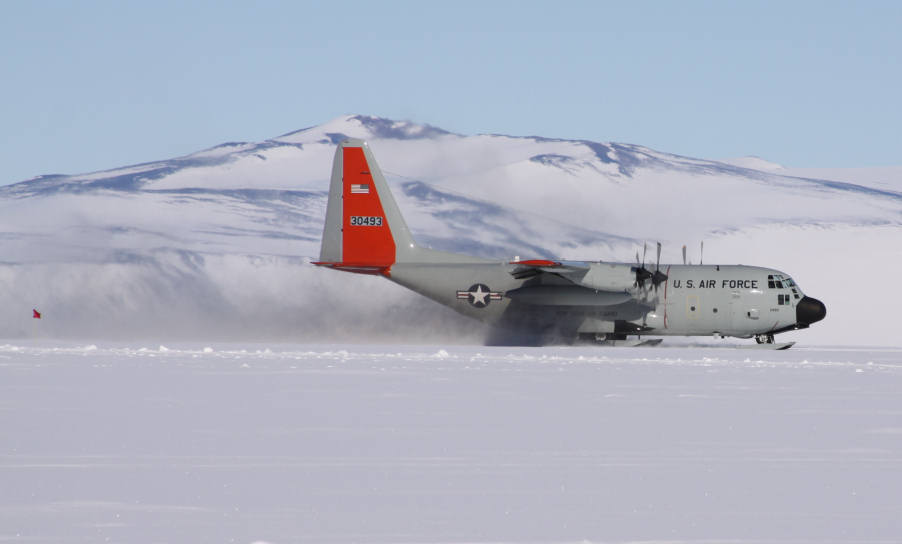
AWI Basler turned up this morning to transfer cargo and personnel to AGAP-North.
AWI Basler with BAS Survey Twin Otter FBL

Sunday, 7 December 2008

Survey Starts

FBL taking off for maiden test flight

As it nears the end of a very busy week that saw FBL the BAS survey Otter arrive late Sunday the survey team completed bag drag in preparation for the flight to South Pole and acclimatisation. We spent 2 days converting the inside of the Twin Otter into an airborne geophysical survey aircraft. Day one of the install saw us install the equipment racks and populated with most of the equipment. Day 2 the remainder of the equipment was installed.

Wednesday the test flight saw the aircraft head over the Ross Iceshelf to the carving front. Though the weather was cloudy our pilots did a fine job of flying the survey. For the first flight the equipment worked with only a few minor issues to solve. Thursday the flying took us over open water so saw us wearing emersion suits just in case, we returned after 3 hours and more confidence that we were ready to transfer to the deep field. Friday was spent tidying up the installation and doing final cargo consignments to Pole. Saturday was a test flight to train a few more operators in how to use the equipment.

Today Sunday was bag drag for the advance survey party to go to South Pole to acclimatise before heading further into the interior and AGAP-North.

Sunday, 30 November 2008

Celebrations’ at McMurdo


FBL arrives at McMurdo

There are strange things done in the midnight sun; by the men who graft for BAS.
It was with glee that they did see; Foxtrot Bravo Lima inward bound in time for tea.

NSFs patients were rewarded as the British Antarctic Survey Twin Otter arrived in McMurdo. Just as the aircraft touched down a two day national holiday was declared to celebrate this important occasion or it could of just have been it was thanks giving! Prior to the arrival of the VP-FBL the BAS team in McMurdo have been preparing the equipment for a fast install and a concise test flying period before departing to Pole for acclimatisation. The various training courses that are required before field deployment were completed; drugs prescribed and fat reserves were built up for the -35°C and below temperatures.

McMurdo is not unfamiliar to British polar explorers with both Scott and Shackleton based out of McMurdo Sounds for Antarctic adventures, so it was interest that the AGAP team visited their historic huts. Inside the huts it was like the explorers had just left expecting to return, provisions were neatly stacked upon shelves and in boxes ready for the following season. Some of the items were familiar though the brands and colours were somewhat different, but the good stuff has stood the test of time. Interestingly many of the boxes had sponsors names on them; there was even a Shell one!

With FBL onsite the work is progressing in earnest in order to complete the survey.

Wednesday, 26 November 2008

Ground level surveying

Now this is not the end. It is not even the beginning of the end. But it is, perhaps, the end of the beginning. Preparation continued in earnest with the surveying of the runways at Williams Field. As with everything McMurdian, bureaucracy reigned for 2 days as we searched out those who could give permission and those who would be able to actually install the system onto their vehicle and carry out the survey. Finally after an endless quest we tracked down Marty well at least a Marty unfortunately the wrong one the correct one was in an all day meeting. The Quest continued into the second day and Marty was located and Jason the Challenger driver of the vehicle that is used to groom the runway was contacted. Early in the morning a survey GPS was attached onto the groomer and the first surveying (ground) of the AGAP season was undertaken. For over a day the GPS collected data as the Williams Field runways were accurately surveyed, this data will be used to compare against and calibrate the aircraft sensors.
Runway Survey
Mean while back in Rothera the British Antarctic Survey Otters arrive and were worked on around the clock to allow them to be ready to continue onwards to McMurdo for the survey Otter and AGAP for the utility Otter. We will come back to the progress of these red Twin Otters in the next few days.
Rothera Station - A faint outline of a Twin Otter can be just be made out
As Thanksgiving approached on the McMurdo base the BAS survey team did a shift in the kitchens in the preparation for coming banquette. Turkeys were stuffed, potatoes were sorted according to size so they would bake correctly, yogurt made and the other festive trims not entirely familiar to the British helpers were prepared. Anticipation is growing here at McMurdo as people wait for the Thanksgiving meal and some well earned rest, but on the BAS side we are anticipating working in order to get ready for test flying and departure to the Pole and the acclimatisation camp. To support the departure of the survey team to the acclimatisation camp, logistics and the shipping of the survey spares and base stations is been organized over the next few days.

Sunday, 23 November 2008

Caves, huts and castles

With the anticipated arrival of the Twin Otter next week the team have started to unpack the boxes and test various field equipment and science equipment that will be installed onto the aircraft. The aircraft cabin heater system that we had developed in house at BAS performed well during initial testing on the sea ice at William Field, though some initial repair work had to be carried out to remedy the damage sustained in transportation. Also we set up a weather fax that will allow our pilots to make calls on the survey lines that can be flown that day to avoid areas of bad weather thus maximising our ability to go survey flying.
Installation of weather fax
Our gravity specialist has spent the last week carrying out test on the gravimeter and checking its correct operations before it is installed into the aircraft.
Gravimeter been setup and tested
Likewise our radar expert has been creating the configuration files required to get the best out the system when we will be flying over the Dome A region. As well as testing the equipment the underlying logistics for the program has also continued including flight planning, onward shipping of spares and the NSF logistics that enables this project to progress.

Sunday a rest day at the base in McMurdo allowed us time to do one of the trails that have been created around McMurdo. The one we chose to do was the Castle Rock loop trail which sets off from McMurdo and heads up towards Arrival Heights before heading off across the glacier towards Castle Rock. The walking was not too strenuous but been able to see miles out in front through such clear air makes things appear closer than they are so you get the impression that it is taking longer than it should to walk the distance. So after about an hour and half trudging across the glacier we reached the base of Castle Rock, unfortunately the rock is closed for climbing so we were unable to climb to the top to admire the view. The views from the ridge were quite spectacular looking down onto the frozen Ross sea, though it was a bit overcast so Mount Erebus was obscured from view, I guess we will hopefully make it back round the loop on a clear day and see Erebus as it is meant to be the best location to view it from. We continued down the glacier towards the ice shelf with the clouds chasing us, from there it was a long hike along the ice road toward the base. All in all it was a good walk taking about 3 hours 40 minutes.
Castle Rock
The previous weekend we visited the historical hut at Cape Evans, this was interesting to see all the historical food, tools and items the likes of Scott and Shackleton used on their Antarctic Expeditions. There was box after box of Fry’s coco they drank some but some was used to cut up icebergs to allow the ships to escape the sea ice. The coco been dark heated up and melted through the ice eventual cutting the iceberg it to bits. Along with the coco was seal meat and penguins eggs they collected to eat, these day because of the Antarctic treaty we no longer eat the local populous but the food prepared in the kitchens by the chefs. Hanging on the wall of the hut was Oates bicycle in need of much repair, cannot imagine riding on a bike there in the early 1900s today though with all the machinery there are some hard compacted ice roads which you see the odd cyclist on. The hut used sea weed as insulation so after the short walk up to the cross commemorating the people lost on the early expeditions it was quite warm and welcoming inside.
Hut at Cape Evans
Provisions in hut
On the way back we stopped at the ice caves formed in the ice tongue from Erebus. After negotiating the ice bridge that passed the melt water pool we slide down the ice slide into the cave. Once inside the cave the light was diffused to a blue light and the temperature was icy cold. As there was a mix of sea water ice and fresh water ice, ice crystals grew on the walls forming amazing structures and patterns.
Ice cave blue light
Team spirits are high and with anticipated arrival of FBL the survey aircraft from Rothera where it has just flown into; there is excitement in the air and an eagerness to get the science equipment installed and the show on the road. The team even had time to partake in the traditional skirt party held at Scott Base.